
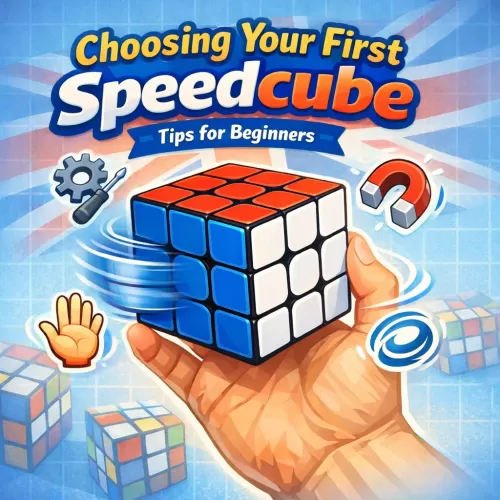
A speed cube should not be chosen only by price, brand or the number of technologies listed in its description. Two modern models may both offer good corner-cutting and competition-level performance while feeling completely different in the hands. One may be extremely light and fast, while another feels firmer, quieter and more controlled.
There is therefore no single best speed cube for everyone. The right choice depends on the solver's level, turning technique, hand size, preferred speed and willingness to adjust the mechanism.
How is a speed cube different from a regular cube?
A speed cube is a twisty puzzle with a mechanism designed for light, fast and repeatable movements. It does not solve the cube for the user or simplify the algorithms, but it allows them to be performed without constantly fighting stiff or catching layers.
A good speed cube normally offers:
- light and smooth turning;
- the ability to handle small underturns;
- magnetic layer positioning;
- protection against frequent pops and corner twists;
- adjustable tension or centre compression;
- a size and weight suitable for finger tricks.
A modern budget model may suit a particular solver better than an expensive flagship. A long list of technologies cannot replace a comfortable and predictable turning feel.
Begin by defining your goal
Before comparing models, answer one question: why do you need a new speed cube?
| Situation | What matters most | Type of model to consider |
|---|---|---|
| First modern speed cube | Control, medium magnets and straightforward adjustment | Budget magnetic model with springs |
| Moving from the beginner method to speedsolving | Stability, good corner-cutting and room for more speed | Adjustable entry-level or mid-range model |
| Regular practice and competitions | Predictability, suitable magnet strength and comfort during long sessions | Mid-range or flagship model matched to the solver's style |
| Very high turning speed | Stability, a magnetic core and fast layer alignment | Ball Core, MagLev or an advanced spring model |
| Small hands or one-handed solving | Compact dimensions and low weight | A cube measuring approximately 54–55 mm |
Someone who is only learning their first complete solve rarely needs a complicated flagship. A solver who is already confident and wants to reduce their times can make a more precise choice based on feel and turning style.
Consider your level, but do not look only at your solve time
Solve time provides a rough indication of a person's needs, but it should not be the only criterion. Two people with the same result may have completely different turning styles.
A beginner or someone who has recently started learning a speedsolving method usually benefits from:
- moderate rather than extreme speed;
- clear magnetic positioning;
- stability during inaccurate movements;
- straightforward adjustment;
- the ability to use the factory settings comfortably.
A more experienced speedcuber may choose between fast MagLev, calmer springs, different magnet strengths, a magnetic core and several surface finishes.
Identify your turning style
It is useful to evaluate your technique honestly before choosing a cube.
A smooth and accurate style means that the solver completes turns cleanly, rarely overshoots and prefers continuous, controlled movement. A light cube with free turning and moderate magnets may suit this style.
A sharp or aggressive style involves fast movements, stronger input and more frequent layer misalignment. This type of solver generally benefits from stronger magnets, a stable core and a slightly firmer setup.
A cautious beginner style involves slow algorithms and frequent pauses. In this case, a clear end to each turn matters more than maximum speed.
Speed or control?
The fastest cube does not necessarily produce the best results. When the mechanism constantly moves beyond the required position, the solver loses time correcting mistakes and breaks their rhythm.
An excessively fast speed cube may:
- react to accidental touches;
- overshoot the intended position;
- feel unstable;
- require highly accurate finger control;
- increase catches when the turning technique is imprecise.
A model that is too slow or stiff also causes problems by tiring the hands and making longer algorithms difficult.
For most users, the ideal choice is a balance: the cube should begin moving easily but stop confidently at the end of a turn.
How to choose magnet strength
Magnets between corners and edges help the layers settle into position. The feel depends not only on the stated strength but also on piece weight, mechanism speed and overall construction.
- Weak magnets suit users who prefer light and free movement. They create little resistance at the beginning of a turn but provide less assistance when the layer stops.
- Medium magnets are the most versatile option. They provide clear positioning without making the cube feel overly sticky.
- Strong magnets improve stability and suit aggressive turning, although more force may be required to begin each movement.
When the user does not yet know their preference, medium magnets are the safest starting point. Adjustable magnets are useful but not essential, as many excellent models use a fixed factory system.
Springs or MagLev?
A traditional mechanism contains springs beneath the centre caps. They create elasticity, hold the structure together and provide a characteristic spring response.
A spring cube generally feels:
- more composed and predictable;
- slightly firmer at the beginning of a movement;
- suitable for someone who values control;
- less “floaty” than a fast MagLev version.
In a MagLev system, the traditional springs are replaced by repelling magnets. This removes spring friction and often makes the turning lighter and faster.
MagLev is worth considering when the solver enjoys very free movement, performs finger tricks quickly and can control a sensitive mechanism. A beginner may find this level of speed excessive.
MagLev is not automatically better than springs. They provide two different turning characteristics rather than two consecutive levels of quality.
What does Dual Adjustment provide?
A standard screw controls the distance between the pieces and the overall looseness of the mechanism. Dual Adjustment additionally allows the elasticity or compression of the centre to be changed.
This makes it possible to adjust separately:
- how freely the layers can move away from alignment;
- how quickly they return to a stable position;
- whether the cube feels flexible or firm;
- how it behaves during aggressive turning.
A good versatile example is the MoYu RS3M V5 Dual Adjustment Magnetic. It combines an accessible price, magnets and separate tension and compression adjustment without requiring the buyer to pay immediately for MagLev or Ball Core.
A new cube should first be used with its factory setup. Parameters should then be changed gradually and kept equal on all six sides.
What is Ball Core and who needs it?
Ball Core, or a magnetic core, adds magnetic interaction between the centre mechanism and the corner pieces. It does not replace the regular magnets between pieces but works together with them.
A magnetic core can:
- make the cube feel more solid and stable;
- help a layer continue towards the correct position;
- reduce small misalignments at high speed;
- create stronger auto-alignment;
- make transitions between fast sequences easier.
Ball Core is particularly useful at high turning speeds, but it is not necessary for good results. A speedcuber with accurate technique can be very fast on a regular magnetic mechanism.
How important is auto-alignment?
Some modern flagships can complete part of a turn after a light push. This effect is created by a combination of geometry, piece magnets and a magnetic core.
Strong auto-alignment does not suit everyone. It helps during fast, confident turning but may feel as though the cube is taking too much control of the movement.
A person who prefers complete manual control may enjoy a calmer spring cube with a moderate magnetic core. A solver with aggressive TPS may prefer a model with strong layer completion.
Frosted surface or UV coating?
The surface does not affect the logic of the solution, but it significantly changes the grip and feel.
Matte or frosted plastic generally:
- shows fewer small scratches and fingerprints;
- does not produce strong reflections;
- feels drier under the fingers;
- may feel slightly slippery in some hands.
UV coating is a glossy protective layer. It normally:
- provides a more secure grip;
- makes the colours bright and glossy;
- protects the external plastic from minor wear;
- shows fingerprints more clearly.
UV coating does not make the mechanism faster. Paying extra makes sense when the solver likes a glossy surface or finds ordinary plastic too slippery.
Size and weight
Most modern 3x3 speed cubes measure approximately 55–56 mm. This suits the majority of users.
A compact model of around 54 mm may be convenient:
- for smaller hands;
- for children and teenagers;
- for one-handed solving;
- for a solver who prefers short, compact finger tricks.
One example is the DaYan GuHong Pro+ 3x3 M 54 mm Spring. It combines compact dimensions, a spring mechanism, a magnetic core and modern adjustment.
Very light cubes cause less hand fatigue, but some users find them hollow and overly sensitive. A heavier model may feel more stable, although it places more strain on the fingers during long practice sessions.
Sound and turning character
Descriptions often use words such as “soft”, “dry”, “crisp”, “muted” or “clicky”. These are not strict technical measurements but attempts to describe a subjective feel.
- Soft turning generally feels smooth, with less abrupt contact between pieces.
- Dry turning provides a clearer sensation of the plastic and internal parts.
- Clicky turning is associated with noticeable magnetic positioning.
- Muted turning normally feels quieter and denser.
For someone who practises late at night, in a classroom or in an office, sound may be as important as maximum speed.
Should a new speed cube be adjusted and lubricated immediately?
Most good models can be used directly out of the box. There is little reason to change every setting before completing several dozen solves and understanding the cube's natural character.
Adjustment becomes necessary when a specific problem can be identified:
- the cube is too loose and unstable;
- turning is too tight;
- the layers constantly overshoot;
- the mechanism catches frequently;
- the turning is too dry, noisy or fast.
Lubricant can change speed and feel, but it cannot correct a model that is unsuitable in its size, magnet strength or overall character.
Which budget should you choose?
Speed cubes can be divided loosely into three groups:
- Budget models provide a full magnetic mechanism and sometimes Dual Adjustment. Their capabilities are sufficient for most beginners and recreational solvers.
- Mid-range models add a more refined feel, a magnetic core, additional adjustment or an improved surface.
- Flagship models combine Ball Core, MagLev, adjustable magnets, UV coating and advanced tuning. They offer more possibilities but require an understanding of personal preferences.
An expensive cube does not reduce solve times automatically. Recognition, fewer pauses, algorithm knowledge and turning accuracy have a much greater effect.
Examples of speed cubes for different preferences
The following models do not form a ranking. Each is suitable for a particular situation.
Affordable and adjustable all-round option
The MoYu RS3M V5 Dual Adjustment Magnetic suits someone who needs a modern everyday speed cube without a flagship price. Its mechanism can be adjusted, and it is suitable for moving from beginner solving to regular timed practice.
Compact model for smaller hands
The DaYan GuHong Pro+ 54 mm Spring is worth considering for users who prefer compact dimensions, spring feedback and soft, controlled turning.
Controlled flagship with springs
The X-Man Tornado V4 M Flagship combines a magnetic core, magnet adjustment and a traditional spring character. It suits a speedcuber who values stability and control without an excessively free MagLev feel.
Fast flagship with UV coating
The X-Man Tornado V4 M Pioneer UV Coated is aimed at someone who enjoys lighter, faster MagLev turning, a magnetic core and a grippy glossy surface.
Maximum-technology model
The MoYu WeiLong V11 20 Magnet Ball Core UV MagLev offers a reinforced magnetic core, MagLev and UV coating. It is better suited to an experienced user who already knows that they want high speed, strong alignment and extensive adjustment options.
Should you buy a speed cube without trying it?
When shopping online, look beyond the promotional model name. The following information is particularly useful:
- size and weight;
- springs or MagLev;
- whether a magnetic core is present;
- fixed or adjustable magnets;
- frosted or UV-coated surface;
- the level and turning style for which the model is intended.
When visiting a shop is possible, it is helpful to hold several models. An expensive cube may appear impressive on paper, while a simpler model may immediately feel more natural.
Common mistakes when choosing
- Buying a model only because a famous speedcuber uses it. A professional may have a different turning style and a customised setup.
- Choosing the maximum number of technologies. Ball Core, MagLev and UV are not necessary for every user.
- Assuming the fastest cube is the best. Without control, additional speed produces mistakes.
- Changing every setting immediately. The factory character of the model should be understood first.
- Ignoring size and surface. An uncomfortable grip can spoil even an excellent mechanism.
- Expecting an automatic improvement in results. A new speed cube supports technique but does not replace practice.
Quick selection checklist
Before buying, answer the following questions:
- Is maximum speed or control more important to me?
- Do I turn smoothly or aggressively?
- Do I enjoy strong magnetic positioning?
- Do I prefer spring feedback or a free MagLev feel?
- Do I need a magnetic core?
- Is a standard size comfortable, or would 54–55 mm be better?
- Do I prefer a frosted or glossy UV surface?
- Am I prepared to adjust the cube myself?
- Will I practise regularly or solve only occasionally?
- Do I genuinely need an expensive flagship?
The right speed cube is not necessarily the fastest or most expensive. It should suit the owner's hands and technique, complete movements confidently and allow the solver to concentrate on recognition, algorithms and consistent solves.
No downloadable files available.
No videos available.