
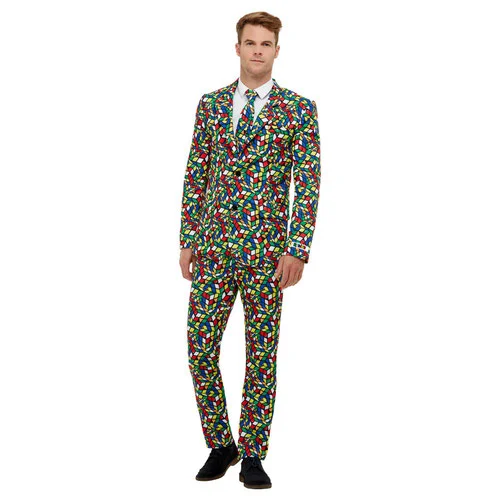
It is possible to begin solving a Rubik's Cube at any adult age. No special mathematical ability, exceptional memory or fast reactions are required. Solving is learned as a gradual skill: the person understands the purpose of each stage, memorises several algorithms and progressively learns to recognise the necessary pieces.
An adult usually approaches a new hobby differently from a child, however. They may want to know how long learning will take, whether the puzzle will be too difficult, which model to choose and whether they will immediately have to understand numerous settings. A good first cube should remove unnecessary mechanical difficulties and allow the learner to concentrate on the solution itself.
Why adults begin solving a Rubik's Cube
There may be many reasons:
- a long-standing wish to finally learn how to solve it;
- an interest in logic puzzles;
- a search for an activity that does not require constant screen use;
- a desire to spend time with children;
- an interest in speedcubing and competitions;
- a way to change focus after work;
- a wish to learn a new, structured skill with a visible result.
The goal affects the choice. Someone who wants to solve calmly in the evening may value smoothness, control and moderate noise. A future speedcuber needs a model that can be used both for learning the beginner method and for later timed practice. A technology enthusiast may enjoy a smart cube with an app, although it is not necessary for a first experience.
Is it too late to begin after 30, 40, 50 or 60?
Age does not determine whether someone can learn to solve a cube. An adult may even find the structure easier to understand because they can follow instructions systematically and practise deliberately.
What may change with age is not the ability to learn, but the most comfortable approach:
| Situation | What to consider | Suitable approach |
|---|---|---|
| Younger adult interested in speed | Magnets, stability and room for future practice | Choose a full magnetic 3x3 speed cube from the beginning |
| Busy adult with limited free time | A predictable mechanism and clear learning method | Use short sessions of 10–15 minutes |
| Older adult | Easy turning, contrasting colours and a comfortable size | Learn one stage at a time without rushing |
| Fingers are stiff or become tired quickly | Low turning resistance and no frequent catching | Avoid stiff souvenir cubes and excessively long sessions |
Being older does not mean that a simplified puzzle is required. A classic 3x3 is suitable for an adult of any age when it feels comfortable in the hands and turns easily.
Why a 3x3 is usually the best place to start
For most adults, the classic 3x3 is the best first choice. It is the format that people normally have in mind when they refer to a Rubik's Cube.
A 3x3 offers several advantages:
- more guides and video lessons are available for it;
- the beginner method can be divided into clear stages;
- there is plenty of room for progress after the first solve;
- it can be used to practise speed and finger tricks;
- it is the main speedcubing event;
- one good cube may remain useful for many years.
A 2x2 has fewer pieces, but it is not necessarily a better choice for an adult beginner. A complete solution still requires algorithms, and the absence of visible centres can sometimes make the colour arrangement harder to understand.
Starting with a 2x2 makes sense when someone wants a shorter solution or a compact puzzle. When the goal is to solve the traditional Rubik's Cube, beginning directly with a 3x3 is usually more practical.
A regular cube or a speed cube
A modern speed cube is not intended only for fast solves and competitions. Its light turning often makes it more suitable for learning than a basic souvenir cube.
A stiff regular cube may:
- catch when the layers are slightly misaligned;
- require considerable force for every turn;
- tire the fingers and wrists quickly;
- make it harder to concentrate on an algorithm;
- create the impression that the moves are being performed incorrectly.
A good speed cube tolerates small underturns and allows the faces to be moved with the fingers rather than the entire hand. This is useful even for someone who has no interest in setting records.
Does an adult beginner need magnets?
Small magnets inside a magnetic cube help the layers stop closer to the correct position. They do not reveal the solution or solve the puzzle for the user, but they make the mechanism easier to control.
This is usually convenient for an adult beginner:
- it is easier to feel when a turn is complete;
- the layers are less likely to overshoot;
- the cube feels more stable;
- fewer accidental mistakes occur as the user becomes faster;
- the model remains useful after the beginner method has been learned.
A non-magnetic cube can also be good, but when the difference in price is small, a magnetic model is generally the more versatile purchase.
Control matters more than maximum speed
An adult buyer may easily be attracted by descriptions of professional cubes: extreme speed, MagLev, Ball Core, adjustable magnets and complex tuning systems. The fastest model is not necessarily the best first cube, however.
An overly fast mechanism may:
- move past the required position;
- react to an accidental touch;
- require very precise finger control;
- make slow practice algorithms more difficult;
- feel unstable.
A smooth, moderately fast and predictable cube is a better starting point. Once the technique becomes more confident, turning speed will no longer be a significant problem.
Which size suits an adult?
A standard modern 3x3 normally measures approximately 55–57 mm. This suits most adult hands.
The choice should depend not only on finger length but also on personal comfort:
- can the cube be held securely with both hands;
- can the index finger reach the top layer comfortably;
- does the user need to change grip constantly;
- does the cube slip from the hands;
- does fatigue appear after only a few minutes.
A 54–55 mm model may be more comfortable for smaller hands. A very small cube is not always better: its pieces can be harder to control, especially when the mechanism is light and fast.
What to consider when the fingers or wrists feel stiff
When the fingers become tired quickly or wrist movement is limited, it is especially important to avoid stiff cubes. A good modern model should turn without considerable effort.
Useful characteristics include:
- a smooth mechanism without sudden catching;
- a standard rather than miniature size;
- moderate speed;
- stable magnetic positioning;
- a surface that does not slip easily.
It is better to begin with short sessions and take a break when discomfort appears. The cube should be an enjoyable activity rather than a test for the hands.
Why contrasting colours matter
An adult beginner does not yet recognise the required pieces automatically. When shades are difficult to distinguish, additional time is spent checking the colours.
It is particularly important that the following remain clearly different:
- red and orange;
- white and yellow;
- blue and green.
Someone who wears glasses or has colour-vision differences may find it useful to view the cube under normal household lighting. A bright stickerless colour scheme is often more practical than muted or decorative alternatives.
Stickerless or stickered cube
A stickerless cube made from coloured plastic is generally more practical for regular use.
Its advantages include:
- there are no stickers to peel or wear out;
- the cube is easier to clean;
- the colours retain their original appearance for longer;
- the surface is suitable for daily practice;
- the external colour scheme requires no maintenance.
A stickered model may be chosen for its traditional appearance, but coloured plastic is usually more convenient for a first working cube.
Are complex settings necessary?
An adult may be interested in understanding the mechanism, but this is not required at the beginning. Most good cubes can be used with their factory settings.
Adjustment becomes useful when the user can identify a specific problem:
- the cube is too fast;
- turning feels too tight;
- the mechanism is not stable enough;
- the layers frequently overshoot;
- a firmer or looser feel is preferred.
A new cube should not be disassembled and retuned before the first proper practice session. Sometimes the user simply needs several days to become accustomed to the turning feel.
Is a smart cube with an app necessary?
Some adults find it easier to learn when an app displays moves, measures time and stores statistics. This approach may particularly appeal to people who enjoy technology and measurable progress.
A smart cube is not essential, however:
- a regular magnetic 3x3 is fully suitable for learning;
- an app may distract from understanding the puzzle itself;
- a smart model requires a phone and a connection;
- electronic cubes are not used in official competitions.
A smart model should be chosen because the app and statistics are appealing, not because a regular cube is supposedly too difficult for an adult.
How much should a good first cube cost?
The cheapest cube is not always the most economical choice. When it is stiff and constantly catches, the user may lose interest and later buy another model anyway.
First cubes can be divided loosely into three levels:
- Budget magnetic cube — good enough for learning and everyday solves.
- Entry-level or mid-range model — a more pleasant feel, good stability and room for speed practice.
- Professional flagship — advanced adjustments and extra technologies that a beginner normally does not need.
For an adult's first cube, the first or second level is usually sufficient.
Examples of suitable first cubes for an adult
The following models offer different turning characteristics and levels of adjustment. This is not a ranking: the appropriate option depends on budget, personal preference and future goals.
Affordable first magnetic cube
QiYi Magnetic 3x3 suits an adult who wants an affordable modern speed cube without complicated settings. It offers a crisp and reasonably controlled feel and allows the beginner method to be learned on a full magnetic model.
Calm educational model
Monster Go MG3 Magnetic EDU is designed for teaching children and adults. It may suit someone who values stable behaviour, smooth turning and no immediate need to understand tuning.
Versatile budget speed cube
MoYu RS3M 2020 is suitable both for a first solve and for later practice. It is a well-known magnetic model with a good balance of price, speed and control.
Lightweight modern model for regular practice
MoYu RS3M V5 Standard Magnetic suits an adult who wants a lightweight modern practice cube without paying extra for advanced technologies.
A model with room for later adjustment
MoYu RS3M V5 Dual Adjustment Magnetic is suitable for someone who may later enjoy changing the tension and turning characteristics. It can first be used with its factory settings, with adjustment explored after some experience has been gained.
How an adult can learn more comfortably
An adult often benefits more from understanding the logic of each stage than from repeating moves without context.
A practical learning order is:
- understand which pieces are fixed and how the colours are arranged;
- learn to build the first cross;
- insert the first-layer corners;
- learn the middle-layer edges;
- complete the last layer with several simple algorithms;
- repeat the entire solve with a guide;
- gradually stop using the instructions;
- only then begin measuring solve times.
Practising for 10–20 minutes several times a week is usually more effective than attempting to learn everything during one long evening.
Common mistakes made by adult beginners
- Waiting until the entire solution is theoretically clear. Some understanding appears only through practice.
- Trying to memorise every algorithm immediately. It is easier to learn one stage at a time.
- Comparing progress with children or experienced speedcubers. Everyone learns at a different pace.
- Timing solves too early. A timer adds unnecessary pressure.
- Treating every error as evidence of poor memory. Mistakes are a normal part of learning movements.
- Buying an overly complicated flagship. Numerous settings do not replace practice.
- Using a stiff souvenir cube. An uncomfortable mechanism may spoil the impression of the entire hobby.
Are a timer and other accessories necessary?
Only the cube itself is required at the beginning. A timer, mat, tools and lubricant may become useful later.
A normal phone stopwatch is sufficient for the first timed solves. A professional timer makes sense when the person is practising regularly and wants to become familiar with a competition-style setup.
Quick selection checklist
For most adults, a good first cube has the following characteristics:
- a 3x3 format;
- a modern speed cube mechanism;
- magnetic positioning;
- moderately fast and controlled turning;
- a standard size of approximately 55–57 mm;
- bright, contrasting colours;
- a stickerless body;
- straightforward factory settings;
- an entry-level or mid-range price;
- enough performance for continued practice after the first solve.
The best first Rubik's Cube for an adult is not the most expensive or technologically advanced model. It is a comfortable magnetic cube that turns easily, does not interfere with learning and remains useful after the first independent solve has been completed.
No downloadable files available.
No videos available.